Orchard
The Orchard is a small but symbolically charged location on Animal Farm, its history tracing the arc from the founding ideals of the Rebellion to the corruption and exploitation that follow. Initially a place of burial and natural abundance, it becomes a site where the pigs' privileged access to resources is established, where the bodies of executed dissidents are hidden, and where the memory of the farm's revolutionary origins is gradually buried along with its dead.
Burial Ground and Revolutionary Origins
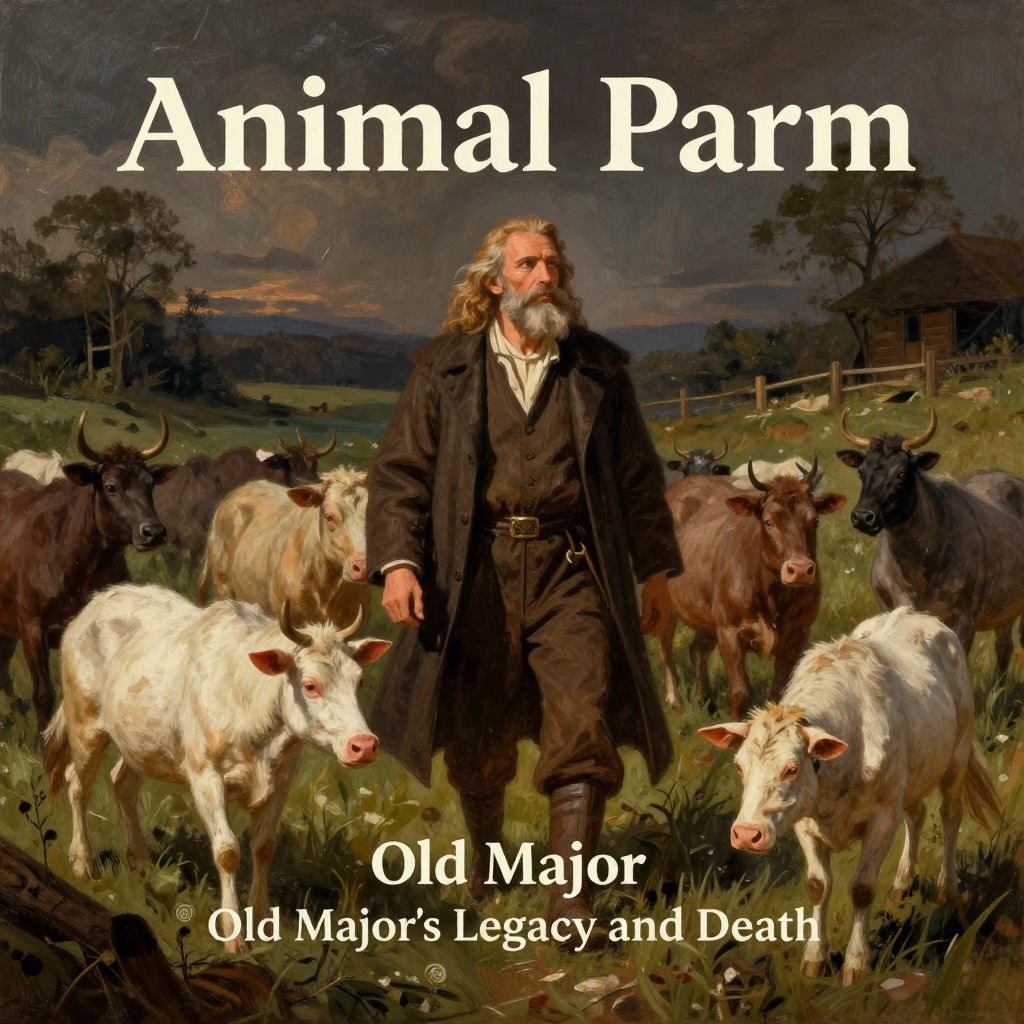
The Orchard first appears as the final resting place of Old Major, the prize Middle White boar whose visionary speech inspired the Rebellion. Three nights after delivering his prophecy of a world without Man, Old Major dies peacefully in his sleep, and his body is buried at the foot of the Orchard. This burial consecrates the Orchard as a site of origin and memory, linking the land to the founding principles of Animalism. Later, after the pigs consolidate power, Old Major's skull is disinterred from the Orchard and set up on a stump at the foot of the Flagstaff, where the animals are required to file past it reverently each Sunday before receiving their orders. The removal of the skull from the Orchard to a ceremonial position marks the transformation of revolutionary memory into a tool of authoritarian ritual.
Contested Resources and Pig Privilege
The Orchard is also the source of the early apples, which become a flashpoint for the pigs' assumption of privilege. As the early apples ripen, the grass of the Orchard is littered with windfalls. The animals assume these will be shared equally, but the pigs order that all windfalls be collected and brought to the Harness Room for their exclusive use. When some animals murmur in protest, Squealer is dispatched to justify the policy, arguing that milk and apples contain substances "absolutely necessary to the well-being of a pig" and that the pigs' health is essential to prevent the return of Mr. Jones. The animals, dreading a return to human rule, accept the explanation, and the Orchard's fruit becomes a symbol of the emerging hierarchy. The small paddock beyond the Orchard, originally intended as a home of rest for animals past work, is later ploughed up on Napoleon's orders and sown with barley, the crop reserved exclusively for the pigs' beer ration.
Site of Execution and Concealment
During the Purge, the Orchard becomes a burial ground for those who resist the regime. When the hens rebel against the order to surrender their eggs for sale to human beings, nine hens die during the five-day standoff. Their bodies are buried in the Orchard, and it is given out that they died of coccidiosis, a lie that conceals the reality of the animals' first organized resistance since the expulsion of Jones. The Orchard thus serves as a place where the regime disposes of the evidence of its own brutality, transforming a site of natural fertility into a graveyard for the victims of political repression.
Memory and Loss
As the years pass and the farm grows more prosperous but the animals' lives remain harsh, the Orchard fades from the narrative as a living space. The older animals, such as Clover and Benjamin, who remember the Orchard as it was in the days of the Rebellion, grow old and stiff. The Orchard's role as a site of memory is gradually erased: the skull of Old Major is buried again, the green flag loses its revolutionary symbols, and the farm's name is changed back to Manor Farm. The Orchard, once the resting place of the Rebellion's founder and the source of contested abundance, becomes just another piece of land, its history buried along with the bodies of those who died for a vision that was never realized.